【Nordost Silver Shadow Coaxial Digital Cable Review】
Part 1|Part 2
With the main system’s amplifier, the TAG McLaren 60i, currently in hospital, sub-system A’s ONKYO A-1VL has been promoted to fill in as a stand-in for the main system. However, being a digital amp, the A-1VL has a wide-range, high-speed sound, so when it’s simply dropped into a system built around the relaxed, sweetish tonal character of the TAG McLaren 60i, the result becomes a rather bare, sharp-edged sound. On first listen you get a jolt of “Oh!”, but it’s not really the sort of thing suited to long listening sessions…
I’m very fond of the digital cable I brought in last year, the Black Cat Cable Silverstar!75, but this sound probably isn’t the best match for the A-1VL. Both have a somewhat dry tendency and a weak point in perceived signal-to-noise, so combining them emphasises the A-1VL’s exposed surface texture and wide-range feel, pushing things in a peaky direction.
That said, the ONKYO A-1VL is only meant to be a temporary seat-warmer, so I’d rather not fiddle with the overall system configuration any more than necessary. ※If I mess about with too many things, then once the original integrated amp comes back from repair, I won’t be able to tell how the sound of the repaired unit has changed compared to before… So what I came up with this time was the idea of leaving the system alone and, at minimum, changing only the digital cable.
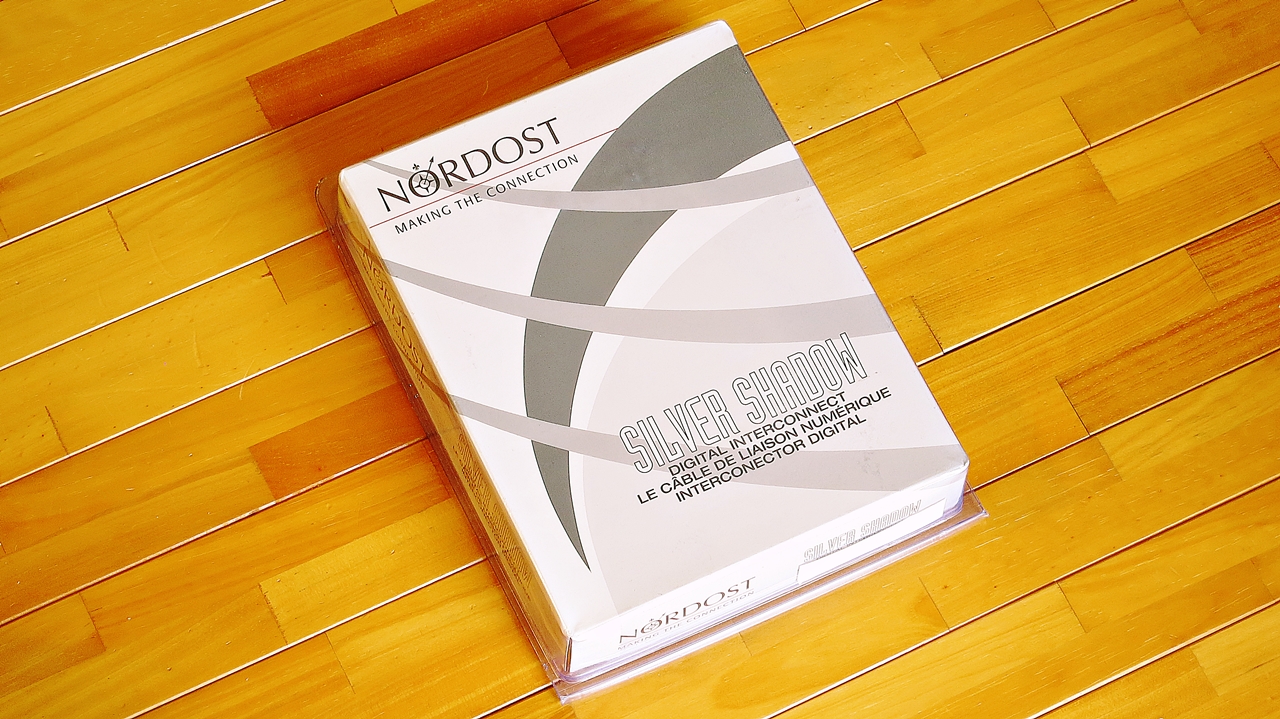
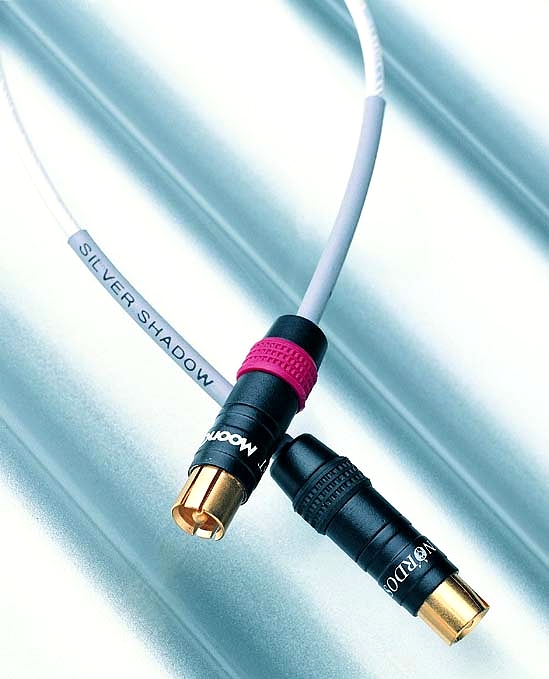
And so, what I got hold of over New Year was Nordost’s coaxial digital cable, the Silver Shadow. I’d wanted this digital cable for over ten years now, but it was too expensive and always out of reach, and before I knew it, while I was sitting there twiddling my thumbs, it had been discontinued… But then, at a certain shop’s Christmas sale last year, I spotted a single unit going at an outrageous price… and before I knew it, it had arrived at my doorstep. Thanks to that, I managed to get it even cheaper than a certain famous overseas shop (which doesn’t ship to Japan) would have charged.
Nordost’s Coaxial Digital Cable Line-up, Construction, and Local Pricing
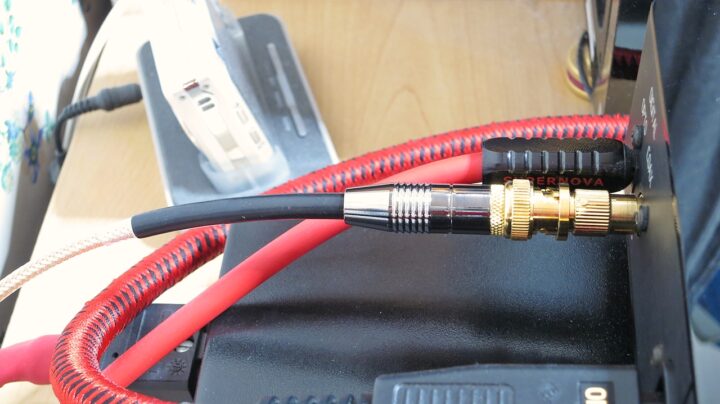
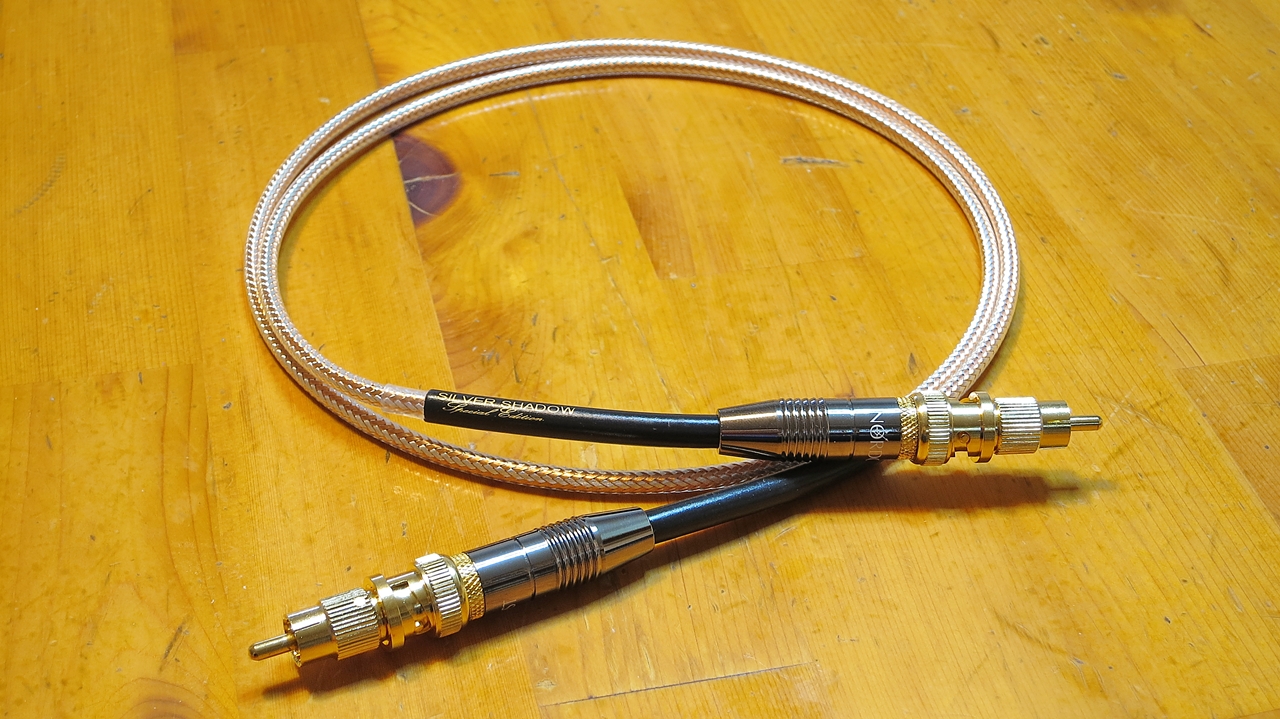
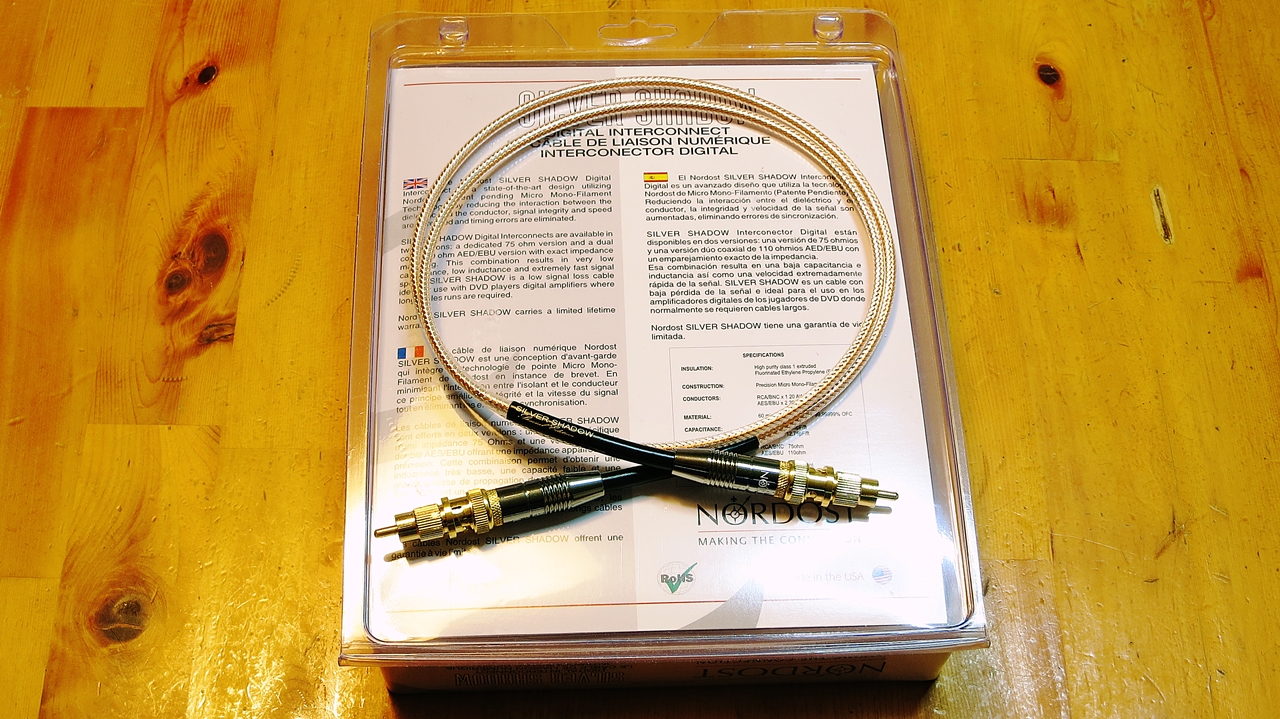
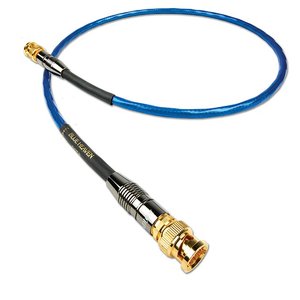
Nordost’s digital cable line-up is smaller compared to their analogue and speaker cables. In the current range, from the bottom, there are five models: Blue Heaven, Heimdall2, TYR2, Valhalla2 and Odin2. The Silver Shadow was an early product released around 1999, and the leftover stock I purchased this time in the Christmas sale is the later version of the Silver Shadow, whose RCA plugs and conductor design were changed partway through the 2000s. It’s the BNC connector type with RCA adaptor plugs included. The home-market list price for the BNC version is $540/m, and $750/m for XLR. Incidentally, the earlier version used NEUTRIK RCA plugs, and the wire itself was a silvery-white colour.
The Japanese importer is Electori. It seems the BNC version was never brought into Japan, so the exact price is unknown, but back when it was in distribution, the domestic list price was ¥63,000/m for the RCA model and ¥80,000/m for the XLR model (product PDF). I was surprised to find the actual selling price was much the same as in the US (if anything, cheaper) — a genuinely reasonable price. Incidentally, all of Nordost’s cables are manufactured in the US, and their sales route is limited to authorised official distributors. You won’t find genuine new or near-new stock circulating cheaply at auction, and in particular, 99% of what circulates on Chinese auction sites is fake. I’d recommend buying either through a trustworthy shop, or, even in the case of used goods, choosing items that can be reliably shown to have come through an official distributor’s route.

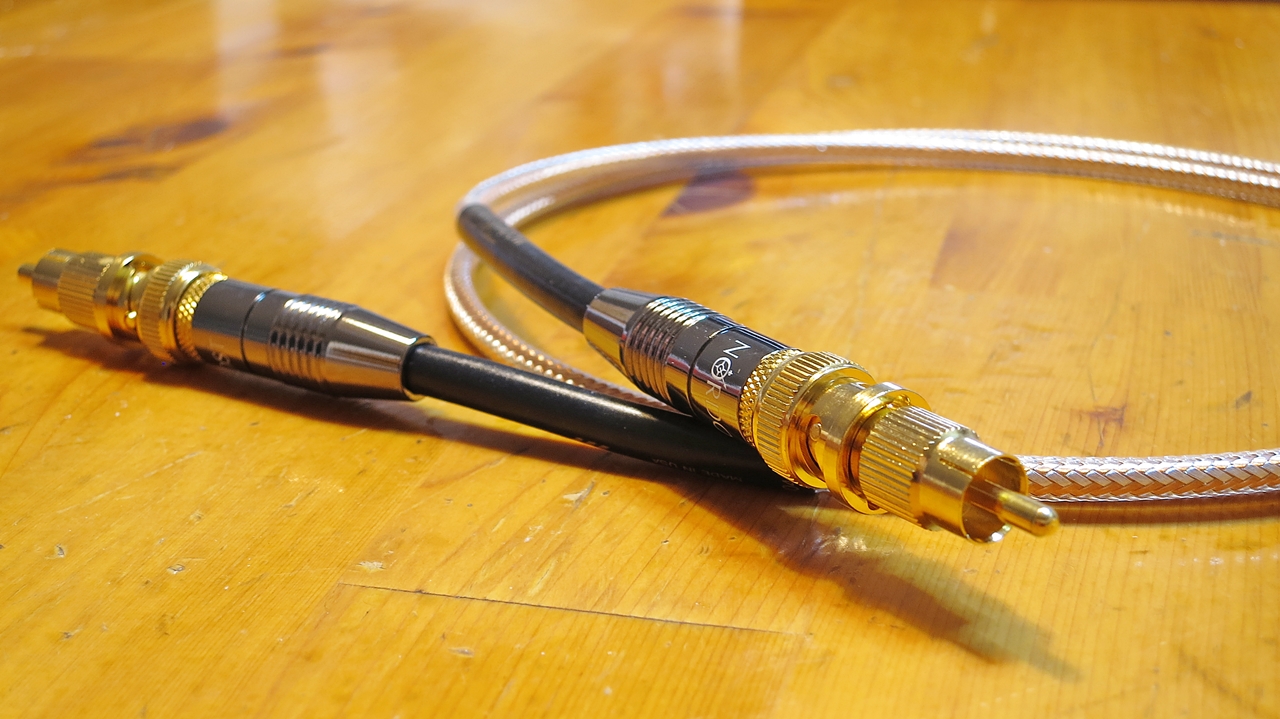
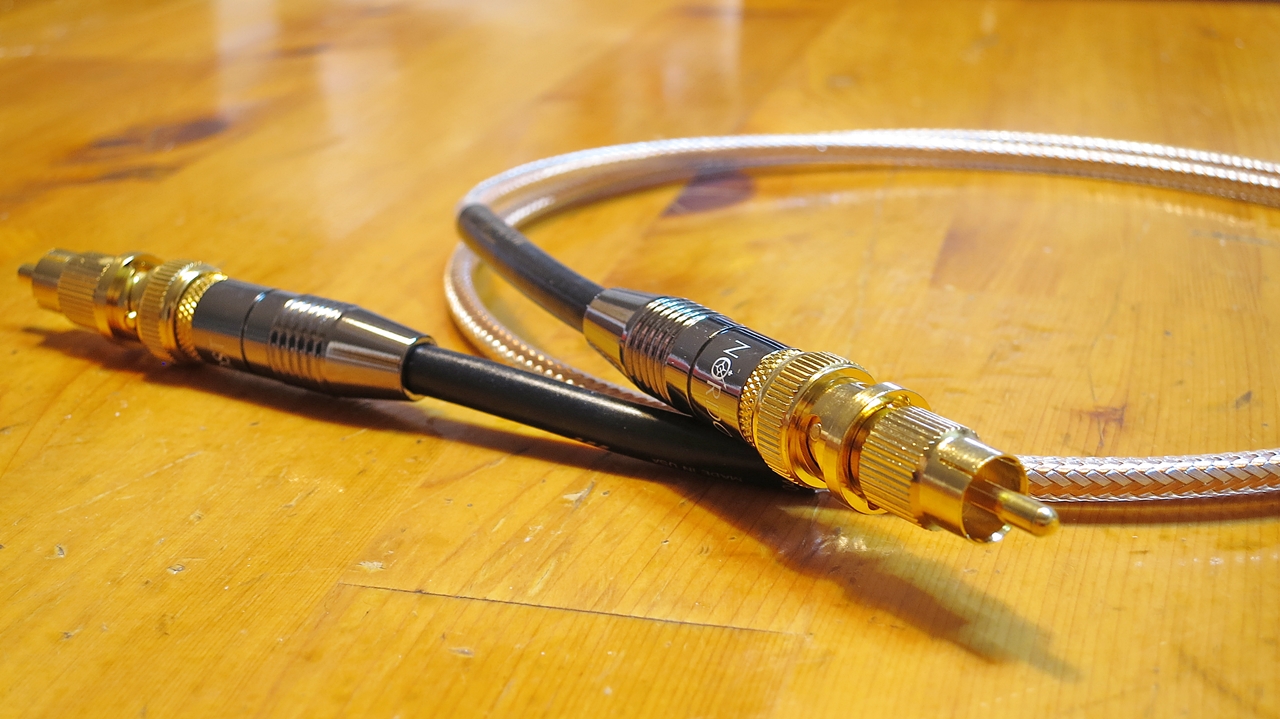
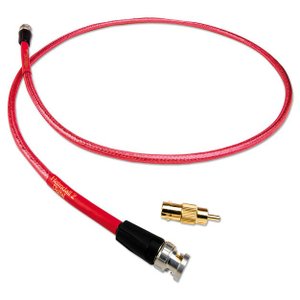
The Silver Shadow is a discontinued model, so it’s no longer listed on the official home-market site, but its construction is a 20AWG 6N OFC coaxial solid-core conductor with 60-micron silver plating. It uses Nordost’s own highly elaborate air-insulation structure, in which a Micro Mono-Filament made of FEP (Fluorinated Ethylene Propylene) material is wound spirally around the conductor for air insulation, and beyond that you can see a gold-and-silver two-tone woven mesh shield through the clear sheath. As for the successor to the Silver Shadow, going by the construction specs it seems to be essentially the Heimdall2. The fine differences between the Silver Shadow and Heimdall2 are that the OFC copper purity went from 6N to 7N, and the transmission speed went up from 86% to 88% of the speed of light… you’ll lose if you think about that one too deeply. Oh, and the colour became bright red. It might be “three times more powerful” in Zeon Principality terms, but personally I preferred the see-through gold-and-silver weave. Incidentally, the Heimdall 2 digital cable has a home-market price of $771.99/m, so it’s generally cheaper to get hold of one here in Japan.
 ポチップ
ポチップ
Silver Shadow Sound Quality Review
Now then, let’s get on with the usual review and impressions. The test was done on the main system. The coaxial digital output of the CEC belt-drive CD player TL5100Z feeds into the CI AUDIO VDA-2 DAC (under repair). Normally the Black Cat Cable Silverstar!75 × XOX75 handles that role, and I’ll be swapping it out for the Nordost Silver Shadow. Incidentally, the analogue connection from the DAC to the ONKYO A-1VL integrated amp is via a DH Labs Pro Studio (under repair) configuration.
The thing you notice immediately upon swapping out the Black Cat Cable Silverstar!75 is that the volume seems to drop a notch (of course, the amp’s volume position stays exactly the same). It’s true that a slightly lighter bass is a common trait across Nordost cables, but beyond that, the treble is also more subdued compared to the Silverstar!75, and I think the perceived volume drops because the extension at both ends becomes relatively gentler. The bass has a springy quality, and it’s the type that develops a soundstage extending deeply front-to-back and side-to-side around the midrange, though on the flip side the vertical spread isn’t all that impressive. It’s quite different from the sound I’d imagined from a name like “Silver Shadow”.
The overall tonal character is gentle on impact, mild and soft to the touch. It’s not the type that goes out of its way to emphasise resolution, but rather a gentle tone coloured with a charming atmosphere. Compared to the more masculine Silverstar!75, the Nordost Silver Shadow could be described as feminine, with a good-natured tonal character. Up to this point it might read like the sort of vague, soft tone you often find in entry-level audio cables. But this is where it shows its true colours as a high-end cable (by the standards of its era), combining Nordost’s characteristic precision on the time axis with a rounded rise-time that is, paradoxically, still high-speed. The tone is bright, as if sunlight were filtering through leaves, wrapped in something like the warmth of a sunlit spot — organic and warm. The musicality is very high, and I get a sense of the kind of expressive dynamics and good sense of timing you’d find in an old PHILIPS CD player.
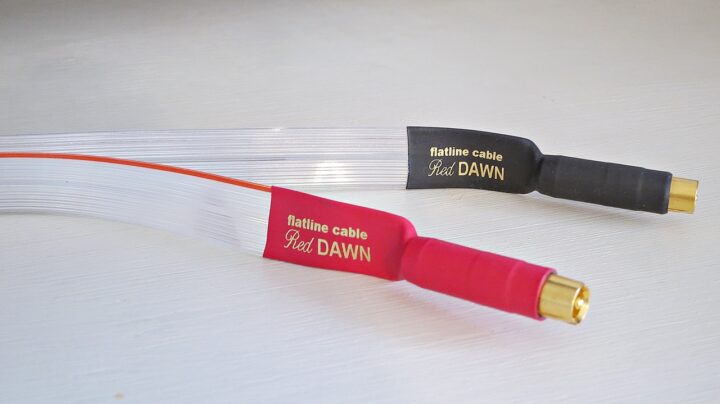
The reverberation is wet, and rather than spreading the soundstage widely, it’s the type where the resonance clings and spills over the image itself. On top of that, a silvery sheen of sorts lightly colours the whole of the music, giving it a very rich and varied sense of colour. Since there’s no raw wide-range or sheer information quantity on display, at first listen it may not sound as accurate or high-precision as you might imagine from RCA cables like the Red Dawn or Blue Heaven. And yet, within its natural texture, it can still depict the swell and decay of resonance clearly, without it blurring together — which hints at a genuinely high precision on the time axis. It can draw out the differences in instrumental tone with real clarity, and there are few cables that show off such a rich sense of colour. The way it renders the allure of a female vocal in particular is wonderful, and that alone feels like a hard-to-find charm.
Having written this far, those of you who have read my other Nordost cable reviews will probably have noticed that, as a tendency, this is quite close in direction to the power cable SHIVA. Unlike the parallel solid-core flat-line construction of the Red Dawn or Blue Heaven, this is a cable with a different character — one that prioritises musicality and lets you enjoy the music through a pleasant deformation of the sound. Its influence on the overall system isn’t quite as strong as SHIVA’s, and it doesn’t go quite so far off the deep end, so the Silver Shadow feels easier to live with in comparison. But it’s still a digital cable of the type that actively adds a high-end-audio-style flourish for you to enjoy, so in that sense it sits at the opposite end of the spectrum from something like the Acoustic Revive DIGITAL-1.0R-TripleC-FM.
 ポチップ
ポチップ
Now, as for how the Nordost Silver Shadow gets on with the main system — compared to the Black Cat Cable Silverstar!75 × XOX75, it has more moisture to it, and even paired with the high-speed, wide-range ONKYO A-1VL, it’s gentle on the ear and never causes listening fatigue, however long you listen — that’s a real charm of it. On the other hand, the scale of the soundstage shrinks a size, and the range narrows at both the bass and treble ends, so compared to the Black Cat Cable Silverstar!75 × XOX75, it leans towards a narrower range and a midrange-centred character.
The Nordost Silver Shadow has an even more rounded, gentle rise-time, and it loses the distinctive, vivid surface texture and directness of energy that the Silverstar!75 has. In the Silver Shadow’s case, the rise is rounded, yet the rhythmic articulation is still high-speed — which is a slightly odd combination, come to think of it. Both digital cables are highly musical, but in different directions: the Black Cat Cable is the type that transmits the musicality of a live performance straight through as it is, whereas the Nordost Silver Shadow is the type that adds on a musicality shaped by the cable maker’s own sense of production, after the fact. As for the sheer amount of information, since this is a cable from a while back, it may feel a touch lacking compared to the latest high-end cables — but I think it’s perfectly suited to gently correcting a system that has a hard, metallic edge to its sound, nudging it towards something more natural.
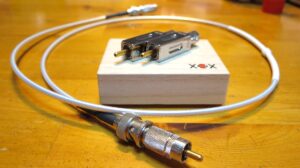
Ever since the Silverstar!75 × XOX75 settled in as the reference digital cable for the main system last year, honestly, I’ve been feeling that at the level of my own system, I probably won’t need anything beyond this for a while. That said, in terms of home-market pricing the Silver Shadow sits above it, and given the expectation that comes with Nordost’s reputation for high performance, I won’t deny that I had, if only in the back of my mind, the possibility of a changeover in view — hoping I might get lucky. But having actually tried it out, the result wasn’t enough to make me go so far as to replace the current cable. The Nordost Silver Shadow is by no means bad, but the Black Cat Cable Silverstar!75 × XOX75 comes closer to the kind of musical reproduction I’m aiming for in my Hi-Fi. This has run rather long, so I’ll continue in Part Two♪

【Nordost Silver Shadow Coaxial Digital Cable Review】
Part 1|Part 2

Auto Translated by CS5