【Audio USB Cable Comparison】
1|2|3 |4|WireWorld Chroma|ELECOM|6 Models|SUPRA
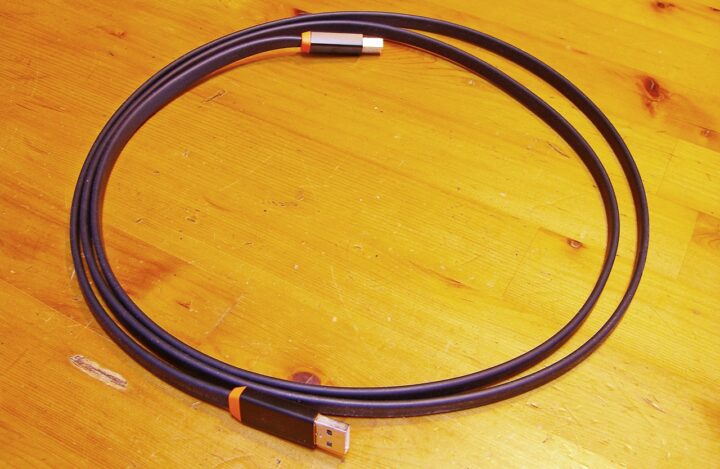
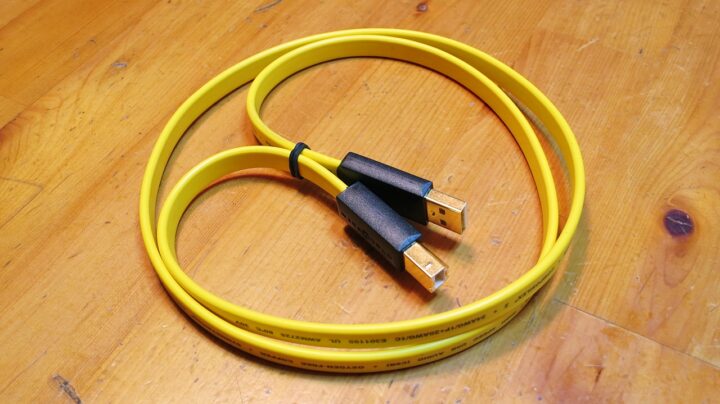
So, based on my impressions this time round, I think the Oyaide d+USB Class A is a USB cable I can recommend — to those whose tastes align with the tonal character I described in the previous entry — as something that delivers a genuinely recommendable level of sound quality. However, yet another problem has emerged here at my place. Due to the cabling layout of the sub system, 1m of USB cable simply isn’t long enough, which means the d+USB Class A is unusable… The testing I did with the Let’s note CF-T2 + DAC-1000 was carried out with a temporary setup on the main system rack, but in my study, where I normally switch between various DACs, it turns out I actually need a USB cable of 5 metres or more.
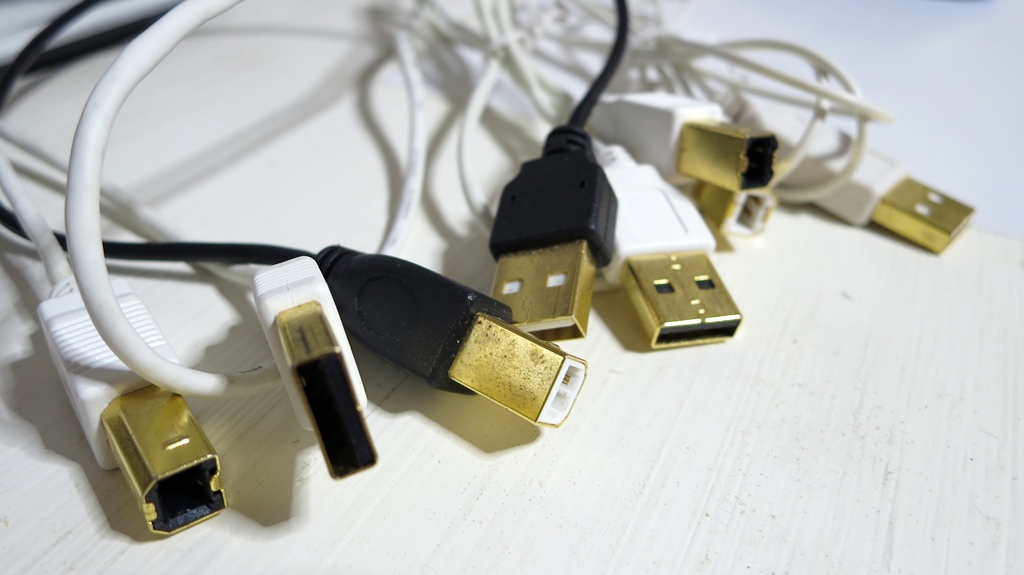
It is generally said that shorter USB cables are better (and I have a sneaking feeling I may have been one of those spreading that idea…), but having tried various things, my current view — revised from where I stood before — is that shorter is not necessarily always better when it comes to USB cables.
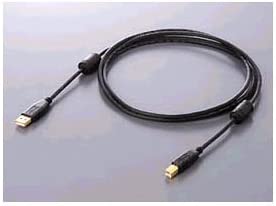
The 5m USB cable I am currently using is the iBUFFALO Arvel AU2SF50BK, which I introduced previously. (It comes in various lengths: AU2SF07BK / AU2SF10BK / AU2SF15BK / AU2SF20BK / AU2SF30BK / AU2SF50BK.)
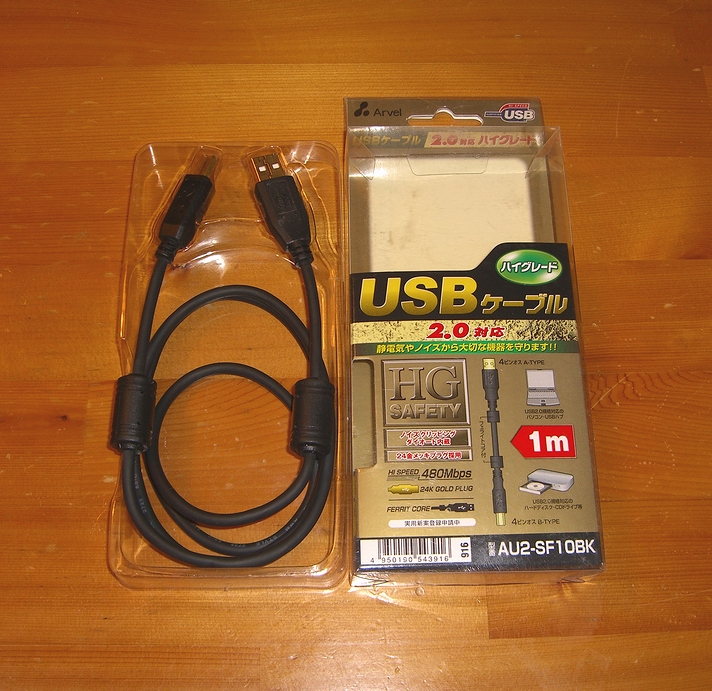
It has a rather elaborate construction — a patented double ferrite core and double noise-clipping diodes — yet it is low in price. At the time I wrote a sound quality review of the 1m version, and liked it enough to subsequently buy the 5m long run. When you pull it out to that length, the character becomes even more pronounced and the changes wrought by the USB cable become that much easier to hear — it ends up sounding even less like what you’d expect from PC audio.
I wrote earlier that sound quality differences between USB cables are small, but once you stretch things out to 5m, the sonic changes become quite impossible to ignore. Even at 5m, in A/B comparisons against other run-of-the-mill cables at 50cm or 1m it sounds clearly better — or rather, more to my taste — and if anything, the deliberate long run seems to saturate the signal more heavily with the cable’s own character, which in turn ends up functioning as a kind of filter to disguise the murky sound quality that a PC transport inherently carries. Or so I think.
The Arvel AU2SF50BK is an unusual USB cable with ferrite cores and noise-clipping diodes at both ends, and I have a feeling there is further potential to be unlocked depending on how those diodes and ferrite cores are deployed as a countermeasure against the various noises that creep in from the PC side. If the conductors were silver-plated or PCOCC, the sound would likely be better still. It is a bit of a shame that the design is locked up by a patent. In any case, long runs of premium USB cable do not come cheap, so for the time being the Arvel AU2SF50BK is my stopgap measure. In terms of outright sound quality, the Oyaide d+USB Class A is clearly superior to the ear — sharper and more transparent — but in a lower-end environment with many noise sources around the PC, the AU2SF50BK may actually be the safer choice.
I read somewhere recently that hum noise and high-frequency noise bleeding from a desktop PC into a DAC-1000 via a USB cable had been reduced to a degree by cutting the ground wire of the USB cable and winding it multiple times around a ferrite core. The point being that noise bleeding and ground loops via USB cables can sometimes reach a level where they become audible as actual noise, rather than merely colouring the sound in some vague, perceptual sense. And even when things are not that overtly bad, there remains the possibility that the latent noise floor is being shifted in ways that affect the listening impression — which suggests that USB, with its isochronous transmission sharing the power supply line, really may be a fundamentally awkward and problematic specification for audio use.

 ポチップ
ポチップ
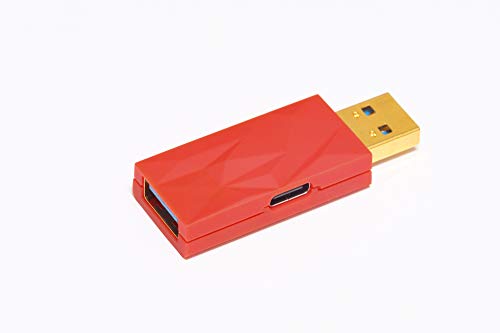
Given how effectively inserting a DDC to convert USB to optical TOSLINK can sever the incomprehensible noise loops that can occur between a PC — an enormous noise source — and an audio system, I am starting to think that approach may be worthwhile beyond just the reclocking aspect. After all, I do not think the output quality of a PC transport has yet reached the point where the S/PDIF quality of optical TOSLINK becomes the bottleneck, as it might in a pure Hi-Fi context. I will write a dedicated entry on the DDC (D/D converter) units I have on hand at some point.
 ポチップ
ポチップ
What I keep thinking is this: the high-quality USB cables currently on the market are, at their core, designed along the same lines as analogue cables — selecting conductors, choosing shielding and connector types, and combining them accordingly. But with USB cables, surely the more pressing question, before any of that, is how to cut off the noise loops bleeding in from the PC side? Pursuing tonal changes through conductor geometry and purity while leaving that problem untouched is hardly getting to the root of the issue. The only products that even attempt to address that aspect, however imperfectly, seem to be the KRYPTON UC-HR series with its separated signal and power lines, and the audio-grade USB cables from Acoustic Revive.
 ポチップ
ポチップ
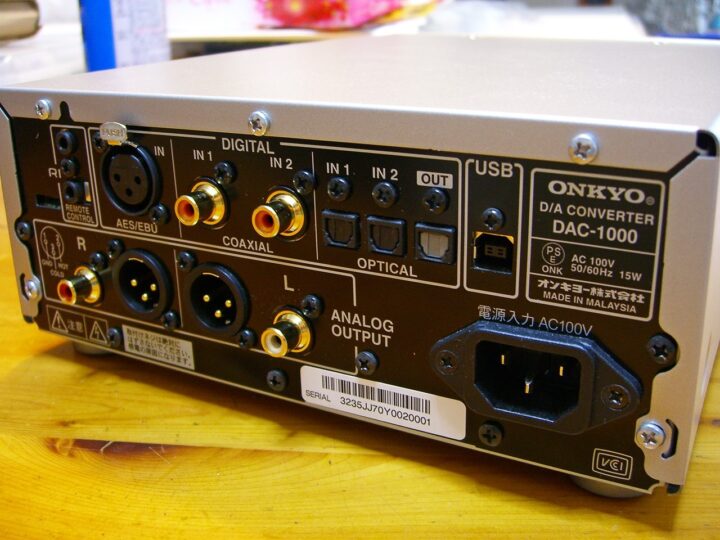
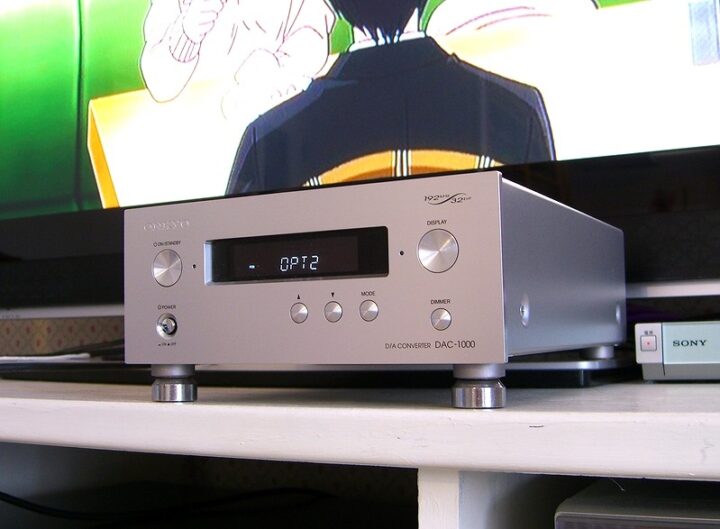
Incidentally, the ONKYO DAC-1000 uses asynchronous transmission, and in other tests I have the Trends UD10.1 USB-DDC (under construction) in the chain for reclocking — so one might think USB cable differences would be irrelevant, but in practice they make a very clear difference indeed. In fact, interposing a DDC seems to raise the overall transparency of the final sound, which if anything makes the sonic differences between USB cable brands stand out even more sharply.
Ah — I should note that my comments above about longer cables not necessarily being a bad thing are premised on an environment using asynchronous transmission or a D/D converter, with reclocking happening on the receiving side. Running a longer cable could potentially have a negative effect on jitter and timing latency… though actually, I wonder whether even a length like this makes any difference at all.
As for the ONKYO DAC-1000 itself, it is inherently a high-resolution, high-definition DAC with the ability to faithfully delineate differences between cables and the sonic character of source transports, so when using it connected to a PC, I felt that a quality USB cable chosen with sound in mind is actually essential to drawing out the DAC-1000’s full potential. Even if you purchased your DAC-1000 through a route other than the direct sales channel that bundles in the Monster Cable DL USB AS-3F as a bonus, I would encourage you at least to give some thought to the quality of your USB cable.
 Audio Specialist Square — USB Cable Listings [PR]
【Audio USB Cable Comparison】
1|2|3 |4|WireWorld Chroma|ELECOM|6 Models|SUPRA


Auto Translated by CS4.6
List of comments (1)
いつも楽しく読ませていただいております。自分は USB 出力は音の悪さで見切りをつけましたが、一度ケーブルに凝ったことがあり、最終的に一番良かったのは、仕事の関係で手に入れた米国製のスーパーコンピューターの内部バスに使われていたケーブルでUSBケーブルを作った場合でした。そのバスケーブルは1メートルのケーブルで、細い50本の線をま止めたものでしたが、幅が10cmほどもある金属のごついコネクターを含めてメーカーの実売価格は250万円ほどでした。その一本一本は2重のシールドがされたφ0.25mmくらいの単線です。音のくっきりさと解像度の感じ(あくまで主観です)が市販のどのUSBケーブルとも次元が違うかなと思いました。この線はアナログ回路に使うとむしろダメなのですが、デジタル部では良い結果を出してくれます。PCよりも、サーバーよりも上位のコンピューターの世界では、ケーブルが重要なのは当然という感じです。