【Bringing Home the CREEK Evolution CD Player】
Part 1|Part 2|Part 3|Part 4
Pairing the ONKYO A-1VL with the CREEK EVO-CD
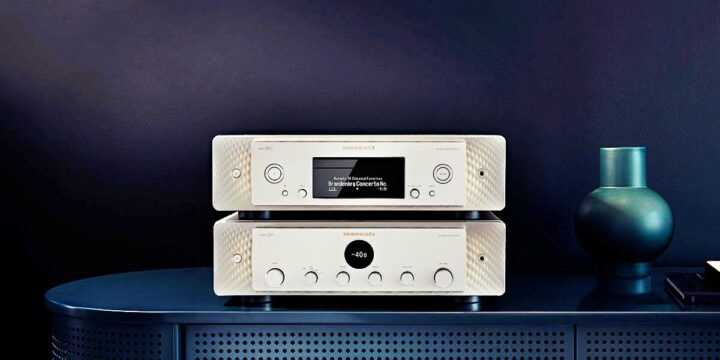
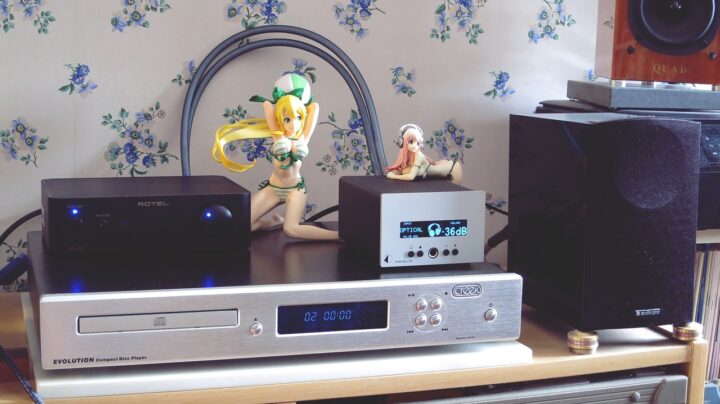
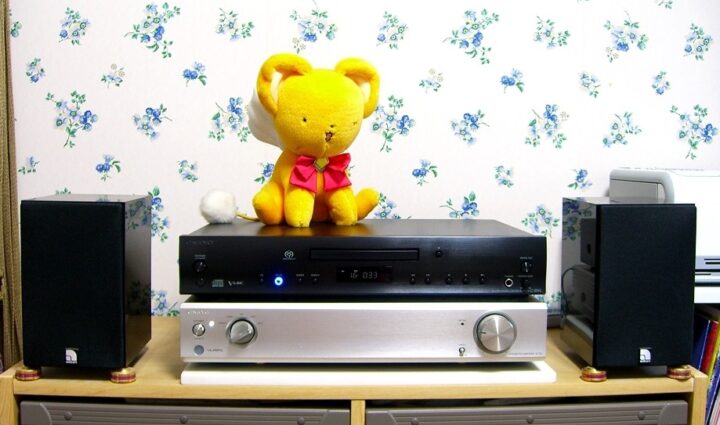
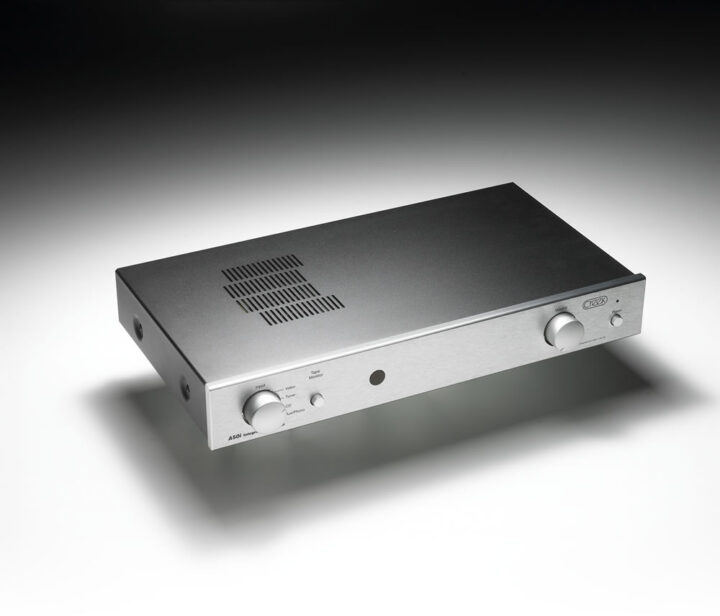
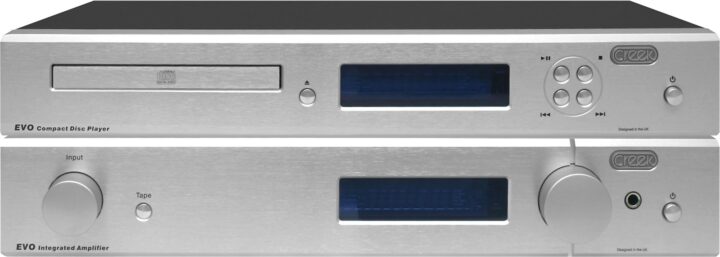
I doubt many people would try this particular combination, but here it is for what it’s worth. Stacked together, it looks something like this. The widths are almost identical and both units have aluminium front panels, so visually they actually suit each other rather well. There is some difference in the hairline finish, but with the chamfering on the top and bottom edges and so on, the design match is good overall — almost giving the impression of a proper matched pair. Also, the ONKYO A-1VL is a Class D digital amplifier and generates very little heat, so placing a CD player on top of it should cause almost no problems, so long as you don’t have them pressed directly together. (Note: in actual use, it might be worth inserting some Hi-Fi insulators or similar to maintain a gap of around 1.5–2 cm, just to be safe.)
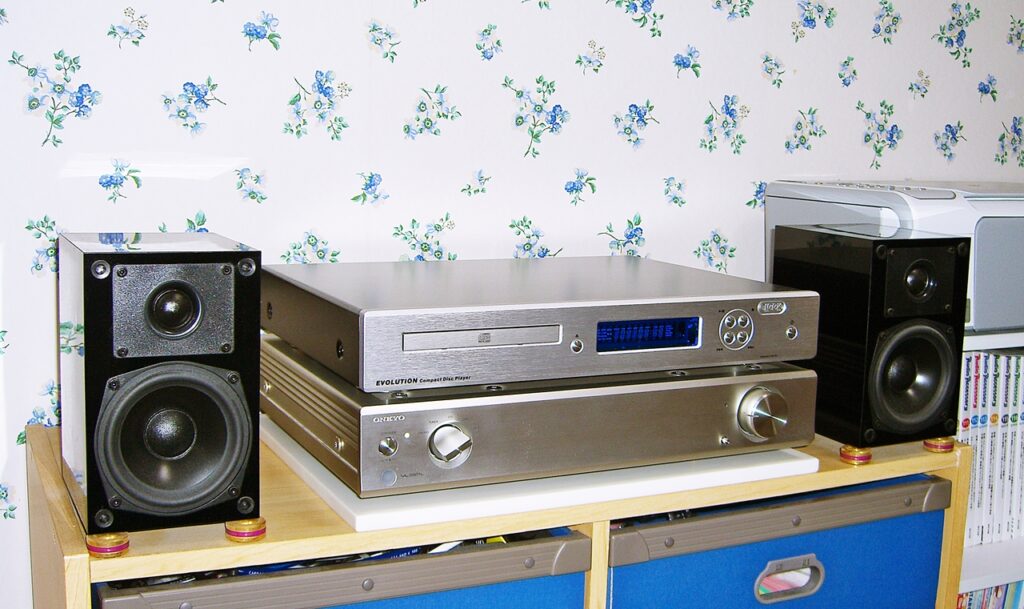
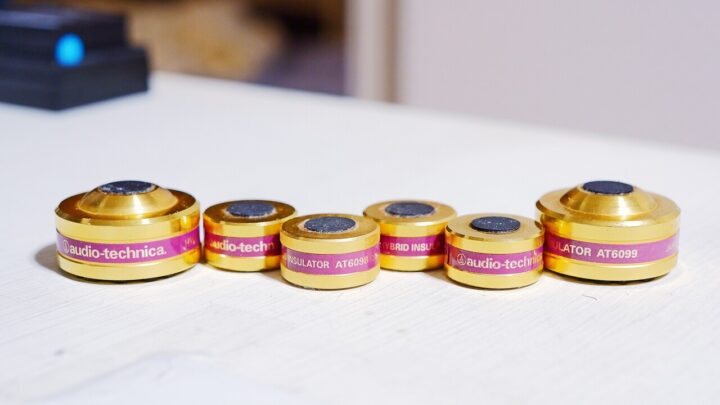
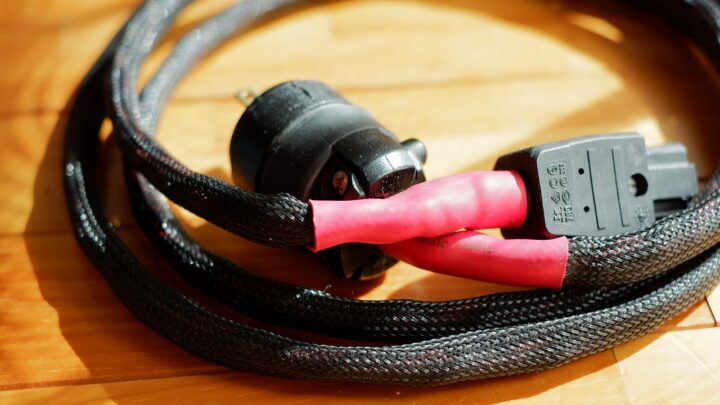
The speakers are the Swedish audiopro IMAGE11. Speaker cable is the British TAG McLaren F3-10SPK. The RCA interconnect is the American STEREOVOX HDSE. Power cables are stock. The power strip is a cheap PC-use unit, and the wall outlet is a Panasonic WN1318. The A-1VL amplifier sits on a 13mm-thick AIRBOW DuPont Corian board, supported at three points by audio-technica AT6098 insulators.
So I went ahead and played some music straight away, and…
Hmm. Hmm. Hmm. To cut to the chase, it simply didn’t work.
First, the sound is harsh on the ears. Everything from the midrange upwards is too hard and edgy, and it all sounds distorted. The transparency is high, but the sound has become so subdued that it feels dead — before you can even talk about musicality. Listening on was genuinely painful. And this is with the HDSE — which, though not the last word in sound quality, does have the virtue of smoothing out distortion. With a combination like this, you would seemingly need to go to very warm-sounding speaker cables and power cables across the board before it became listenable at all.
The Kharma KPL Reference/1a proved to be a good match with the Evolution-CD, so that combination has been in use ever since.
The sound of the ONKYO A-1VL — in terms of low-frequency body and resolution — tends to be somewhat dry and speed-oriented compared to the brightness and shimmer in the mid-to-upper registers; something like the left-hand register of a Yamaha grand piano. As a result, the EVO-CD’s clear low-frequency resolution has no room to shine, and with the bass also feeling thin and insubstantial, the combination falls flat. The C-1VL, too, was a player oriented towards flat, high-resolution, high-fidelity sound, one that nudged the A-1VL’s natural liveliness back towards neutral — but even compared to that factory-matched pairing, this combination produces a far duller, more lifeless sound. If you are going to put together such an odd pairing, you could pick up a  C-1VL for half the price.


 ポチップ
ポチップ
In the end I disconnected the EVO-CD after about thirty minutes. Component matching in Hi-Fi is genuinely difficult. I had thought the A-1VL and the Evolution CD would get on reasonably well, yet this was the result. I have always felt that mastering the art of matching components is mastering Hi-Fi — would others agree?
Comparison with the ARCAM DiVA CD72T
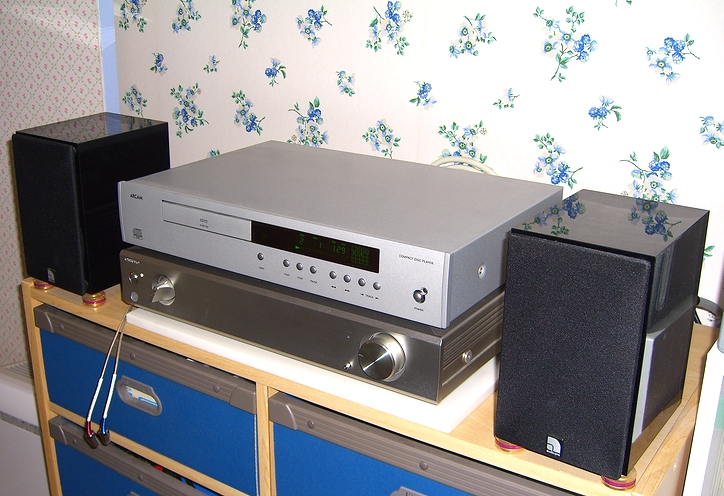
The sound was so dreary it left me feeling quite deflated, so I brought out the ARCAM DiVA CD72T. This time the RCA cable was not the STEREOVOX HDSE but the Isoda HA-08PSR (modified). Well, it sounds perfectly decent. It does not have the refinement or the wide frequency range of the EVO-CD or the C-1VL, but it has a reasonable degree of musicality and a gentle warmth, making it a safe, unproblematic listen. Music is genuinely enjoyable with this. Sound quality-wise, the A-1VL would ideally be paired with something in a higher grade, but still — (normally it has the TL51Z sitting on top of it).
One plus one not adding up to two is precisely what makes separates so difficult. Even with inexpensive components, a good match can yield sound quality many times beyond what the combined price would suggest; and even with high-end gear costing millions of yen, a poor match can produce quite embarrassingly bad results. And on top of that, small changes from individual accessories accumulate — every little thing adds up. As things turned out, the CREEK EVO-CD ended up staying in the main system for a while, in an unplanned turn of events. The analogue-like, distortion-free sound of the C.E.C. TL51Z is something I am reluctant to give up, so what to do — keep both is not really feasible space-wise.
An Unexpected Effect on the Mains Environment
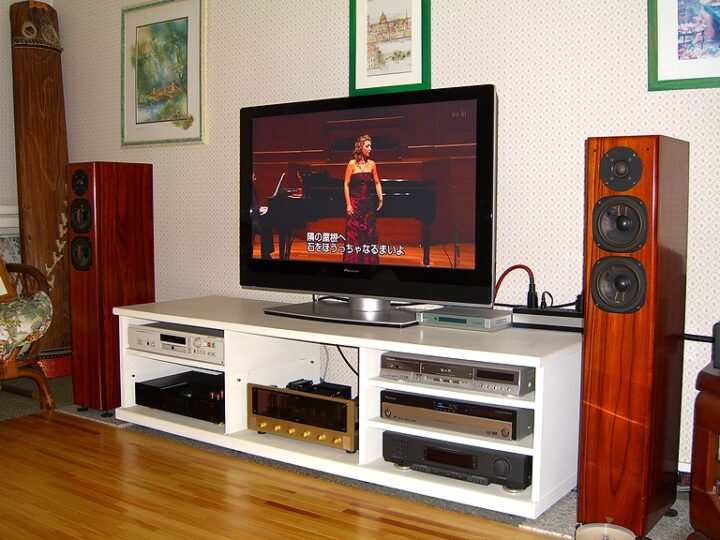
The CREEK Evolution-CD brought a significant improvement to CD playback on the main system, but there is one more thing I noticed today. When the EVO-CD is switched on, the sound quality of the plasma television changes — for some reason. The high frequencies seem to extend slightly and become smoother. Switch it off and the dialogue sounds more muffled, so there is no mistaking it. Note: the external speakers connected to the same integrated amplifier change in the same way.
A parallel-type power conditioner — the PS Audio Noise Harvester, for instance — will alter the sound throughout the entire house when plugged in, so it stands to reason that connecting a player to the same power strip would produce some kind of change. Even so, these subtle shifts tend not to be widely known, and one rather easily fails to notice them. Incidentally, the Evolution CD draws 6W even in standby, yet the effect still appears to differ depending on whether it is on or off. You might expect a CD player to be more of a noise source than anything else, which makes it all the more puzzling that having it switched on should produce a more favourable impression of the sound.

The Performance of the VAM1202 / CDM12.x Series PHILIPS Transport
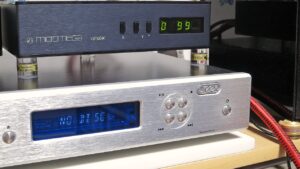
Today I want to test the EVO-CD’s capabilities as a transport. The only DAC I have to hand, however, is the MARANTZ CDR630 in its REC through mode. That unit uses a PHILIPS VAM1202 linear tracking die-cast mechanism paired with a PHILIPS bitstream DAC. The EVO-CD uses the CDM12.x, a non-die-cast linear tracking mechanism that has been adopted by many low-to-mid-priced MARANTZ and PHILIPS CD players over the years — so as a transport mechanism, it is a step below the CDR630.
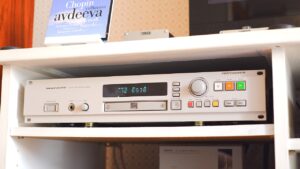
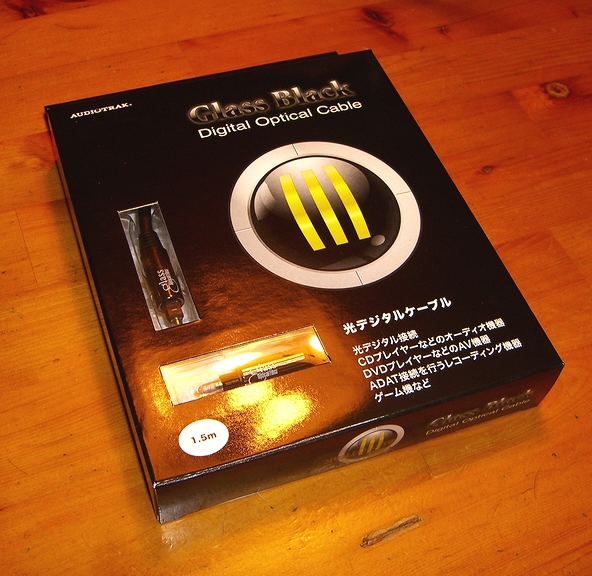
For the digital output I used a TOS-link (optical digital) cable, specifically the TDK OC-6TT10. There are various budget TOS cables out there, and this one is on the softer-sounding side. I bought it on the strength of positive reviews online, but how does it actually sound? The tonality is perhaps a touch mid-centric and a little congested — it may suit those who prefer a softer sound. As an aside, coaxial connections often yield better results than TOS-link, but connecting via coaxial also tends to introduce a blending of characteristics between components in a way that TOS does not, so for critical evaluation purposes I would lean towards TOS. I do have a higher-quality TOS cable — the Nekken Optical Gate — but when I dug it out after a long time, it produced no sound at all when connected. I would like to send it in for repair, but whether they would still accept it at this point is another question. ※ They declined.
Now, let us listen to the Evolution CD used as a digital transport, with the audio going through the MARANTZ CDR630’s DAC. ※ Note: in this combination, the signal locks without any problem even without a sampling rate converter. First impression is that the volume seems slightly lower. This is true compared with other CD players as well, so presumably the CDR630 is simply voiced to sound modest on its analogue output — (the output spec is the same 2.0V). The sound is a touch warmer than the EVO-CD’s own DAC. The frequency range is also narrower, with a midrange-focused character. By comparison, the S/N is not particularly good — or rather, it has an analogue-ish quality to it. For light, musical flow and smoothness in the horizontal dimension, the CDR630’s internal DAC has a slight edge.
However, it lacks the EVO-CD’s ability to draw you into the finer details of the music — that quality of expressive, almost spiritual rendering. In sound quality terms too, there are significant gaps in terms of frequency range, transparency, and information retrieval, and the DAC section feels at least two classes below. What is curious — as always — is that simply feeding the CDR630 the transport data from the EVO-CD, without passing through the latter’s DAC at all, gives the CDR630 a tonal character almost reminiscent of a CREEK CD player. The quality is considerably lower, but if CREEK had made a ¥50,000 CD player ten or fifteen years ago, it might well have sounded something like this.
For comparison, I loaded the same CD into the CDR630 using its own die-cast mechanism as the transport. Oh my. This actually sounds considerably better than the EVO-CD used as a transport via TOS-link. The low end is a little lean, but the high frequencies open up and the narrow impression eases. There is something slightly grainy in the texture, but the information retrieval also increases noticeably. Musically the difference is not dramatic, but things do move in a more lively direction.
The TOS-link cable used this time was not of a particularly high grade, so I cannot state this with certainty, but the conclusion is that the CDR630’s own transport plus the CDR630’s own DAC ultimately outperforms the EVO-CD used as a transport feeding the CDR630. And yet neither comes anywhere near the sound quality of the EVO-CD’s direct analogue output. The CDR630 gives an impression roughly on a par with a CD player in the ¥50,000–70,000 retail class, whereas the Evolution CD, connected to my main system, produces a quite startlingly high-quality sound — so perhaps this is simply a case of the two components being a particularly well-suited match.
 ポチップ
ポチップ
On a different note — while I was searching online for information to write this article, I came across a mysterious spam site that had lifted excerpts from this blog and mixed them up with text from other blogs, or something of the sort. The result is a completely incoherent piece of writing with no logical thread connecting any of it. You would probably only recognise your own writing if you were the one who wrote it in the first place. What on earth is the point of that?

On another note, I noticed the access numbers were going up in a strange pattern again, and when I checked the logs it turned out to be Yahoo Auctions again. Traffic stands out precisely because this site is so quiet. And this time it was both the ONKYO and the CREEK pages. As I have said before, the person listing these is absolutely not me. That said, if the sellers are responsible, well-regarded members of the community, I have no objection whatsoever to them linking to this site in their Yahoo Auctions listings — though if you could manage a brief greeting in the comments section, it would put the author’s mind at ease, somehow.
CREEK Evolution CD Player: My Journey Begins [Part 4]
【CREEK Evolution CD Player Introduction】
Part 1|Part 2|Part 3|Part 4
Auto Translated by CS4.6
List of comments (4)
インプレ、楽しみにしていました。その2とその3、組み合わせでほんとに変わるのですね。メインのほうで、2台の個性的なプレーヤーを使い分けるのは楽しそうですが。うちでも同じく、置き場所の問題はつきまといます。 P.S. SA12S1、修理しつつも元気です。
Kさんこんにちは。SA-12S1修理されましたか。メカ故障か何かでしょうか?
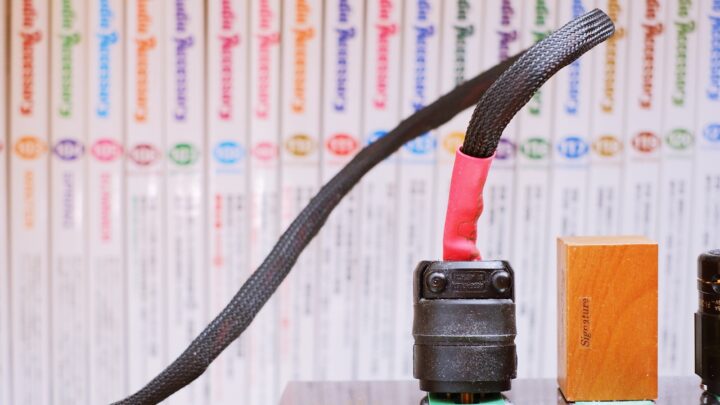
このままA-1VLと組み合わせて使えないのではでは悔しいですので、電源アクセサリ関係のテコ入れで何とかバランス取れないものか思案中です。どうもCREEKの付属純正電源ケーブルが原因で酷い音がしている悪寒が。。。(メインシステムではKharmaのKPC/Reference1aを使いましたので、少なくともここだけで柔らかさと歌うような表現力がプレーヤーに加わりますし、歪み感も減ってるはずですので。。。)
SA12S1はIC交換でした。その後、部品の在庫がきれたらしく、こわれないことを祈るのみです。
オーディオがきれいに鳴ってくれないときは、気分も低下しますね。私の場合、半年くらいして、ようやく使い方のコツをつかむことが多いです。
イメージ11は、経験では、RCAケーブルのちがいを高域によく表しました。それにしても、このCDPとA1VLとの組み合わせで、音がしんでしまうのは、どういう理由なのでしょうね。
>私の場合、半年くらいして、ようやく使い方のコツをつかむことが多いです。
これは私もそうです。一つ何かを替えてしまうとバランスが変化して芋づる式に問題点が吹き出しますから。。。奇麗に鳴ってくれないストレスを分散するために、私は1つのシステムに拘らず、廉価でコンパクトな機器で3つも4つもシステムを組んで、それぞれの音で音楽を楽しめるようにしています。今年はPC系のミニチュアオーディオにもトライしようかしらと♪
>イメージ11は、経験では、RCAケーブルのちがいを高域によく表しました。
Image11は80Hz未満の低音域がバッサリ無いですから…。
音が死んでしまう理由は何でしょうねぇ。。。相性としか説明できなくて申し訳ないのですが、A-1VLは繋げるCDプレーヤーの持つキャラクタに驚くほど素直に追従するアンプですので、EVO-CDの持つ聴感F特の偏りを中和せず、更に増幅してしまうような印象です。
その昔ARCAMのアルファ5+CDプレーヤーを使っていた時も、このCDプレーヤーはCREEK4240では奇麗に鳴るのに、ミュージカルフィデリティA1ジュニアの組み合わせた場合はとても聴いていられないくらい酷い音がしました。EVO-CD+A-1VLどころの騒ぎではなく、耳が変になりそうな音で。同じイギリス製同士なのにです。インピーダンスのズレとか個々の機器の持つ電気特性の違いとかで案外影響があったりするのかも(謎)